Distributed Tracing
Distributed Tracing tracks a message’s path through an application and across service boundaries. Axon Framework provides tracing decorators for commands, events, queries, repositories, state managers, event storage, snapshots, distributed connectors, and annotated handler methods.
Tracing decorators wrap framework components by composition.
SpanFactory is the public abstraction for span creation.
Registering a SpanFactory, or the Micrometer Tracer and Propagator used to create one, enables the decorators discovered through ConfigurationEnhancer services.
Note that the distributed tracing functionality is part of Axoniq Framework and requires a license for production use.
A trace is a collection of related spans. Each span records one timed operation and its relationship to other operations. The following capture shows an HTTP request that dispatches a command through Axon Server and continues through command handling, event publication, event processing, a subscription-query update, and a follow-up command:
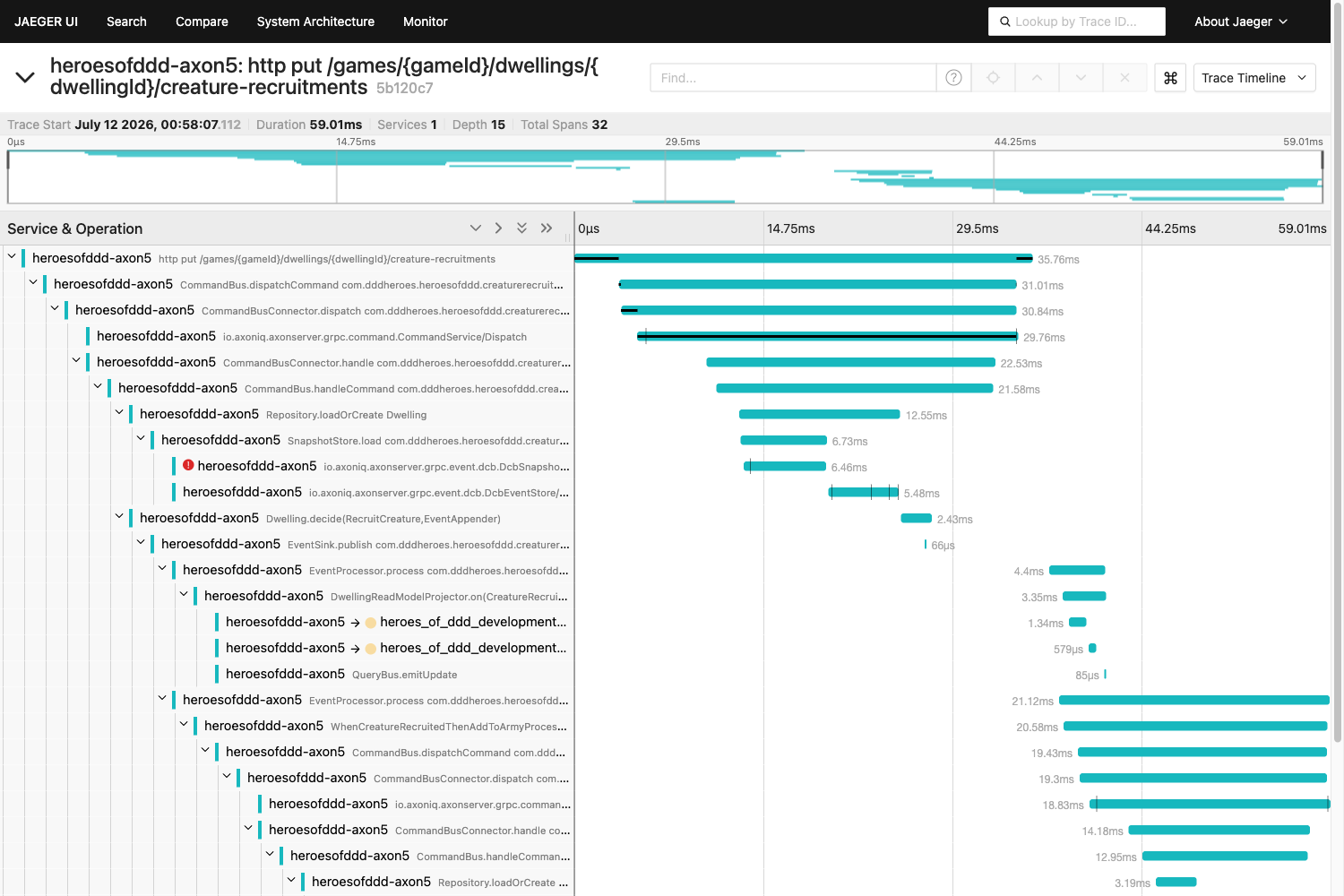
The capture uses axon.tracing.event-processor.distributed-in-same-trace=true.
The default streaming topology uses a separate batch trace linked to the publication trace.
|
Sagas, process managers and deadlines are not available in Axon Framework 5. |
Modules
| Module | Contents |
|---|---|
|
The tracing API, built-in message attribute providers, logging implementation, and decorators for |
|
Decorators for |
|
Decorators for |
|
Decorators for distributed |
|
The Micrometer Tracing implementation of |
Configuration
The declarative configuration API and Spring Boot properties configure the same tracing components.
The Spring properties use axon.tracing.* because the distributed connector and thread-local bridge settings extend the existing shared tracing namespace.
-
Configuration API
-
Spring Boot
Register a Micrometer Tracer and Propagator as framework components:
public MessagingConfigurer registerTracing(MessagingConfigurer configurer,
                                            Tracer tracer,
                                            Propagator propagator) {
    return configurer.componentRegistry(registry -> registry
            .registerComponent(Tracer.class, configuration -> tracer)
            .registerComponent(Propagator.class, configuration -> propagator));
}
The service-loaded Micrometer enhancer creates the MicrometerSpanFactory.
The component enhancers then decorate the components present in the application.
Add the Micrometer binding, Actuator, the OpenTelemetry bridge, and an OTLP exporter:
<dependency>
    <groupId>io.axoniq.framework</groupId>
    <artifactId>axoniq-tracing-micrometer</artifactId>
    <version>${axoniq-framework.version}</version>
</dependency>
<dependency>
    <groupId>org.springframework.boot</groupId>
    <artifactId>spring-boot-starter-actuator</artifactId>
</dependency>
<dependency>
    <groupId>io.micrometer</groupId>
    <artifactId>micrometer-tracing-bridge-otel</artifactId>
</dependency>
<dependency>
    <groupId>io.opentelemetry</groupId>
    <artifactId>opentelemetry-exporter-otlp</artifactId>
</dependency>
management:
tracing:
sampling:
probability: 1.0
otlp:
tracing:
endpoint: http://localhost:4318/v1/tracesSpring Boot provides the Micrometer Tracer and Propagator beans.
The Axoniq Framework binding uses them to create the active MicrometerSpanFactory.
Tracing settings
Spring Boot exposes the following settings under axon.tracing.*.
Declarative applications register the corresponding MessagingTracingSettings, ModellingTracingSettings, EventSourcingTracingSettings, and DistributedTracingSettings components.
| Property | Default | Effect |
|---|---|---|
|
|
Controls the complete tracing autoconfiguration. |
|
|
Controls |
|
|
Controls |
|
|
Controls |
|
|
Controls event-handling component tracing. |
|
|
Controls the streaming batch span. |
|
|
Selects whether eligible event-processing spans continue the publisher trace. |
|
|
Limits which events are eligible for the same-trace topology. |
|
|
Controls per-method spans for |
|
|
Controls |
|
|
Controls |
|
|
Controls |
|
|
Controls |
|
|
Controls distributed command connector tracing. |
|
|
Controls distributed query connector tracing. |
|
|
Controls the worker-thread bridge without disabling span creation or message metadata propagation. |
|
|
Controls the |
Multiple tracing destinations
Axon Framework uses one active SpanFactory.
Exporter fan-out belongs to the OpenTelemetry SDK configuration.
-
Configuration API
-
Spring Boot
Compose exporters before building the SDK:
private SpanExporter compositeExporter(String primaryEndpoint, String secondaryEndpoint) {
    SpanExporter primary = OtlpGrpcSpanExporter.builder()
                                               .setEndpoint(primaryEndpoint)
                                               .build();
    SpanExporter secondary = OtlpGrpcSpanExporter.builder()
                                                 .setEndpoint(secondaryEndpoint)
                                                 .build();
    return SpanExporter.composite(primary, secondary);
}
Expose another SpanExporter bean.
Spring Boot composes the exporter beans into its OpenTelemetry SDK:
@Bean
SpanExporter secondarySpanExporter() {
    return OtlpGrpcSpanExporter.builder()
                               .setEndpoint("http://secondary-collector:4317")
                               .build();
}
Span attribute providers
SpanAttributesProvider contributes searchable attributes to message-carrying spans.
The built-in providers are:
| Provider | Default key | Description |
|---|---|---|
|
|
Message identifier. |
|
|
Qualified message type and version. |
|
|
Message metadata entries. |
|
|
Aggregate identifier when available. |
|
|
Event tags resolved by the configured |
Event tags are resolved when the payload representation needed by the configured TagResolver is available.
If no tag can be resolved, no event-tag attributes are added.
public final class TenantSpanAttributesProvider implements SpanAttributesProvider {

    @Override
    public Map<String, String> provideForMessage(Message message, @Nullable ProcessingContext context) {
        String tenant = message.metadata().get("tenant");
        return tenant == null ? Map.of() : Map.of("company.tenant", tenant);
    }
}-
Configuration API
-
Spring Boot
public MessagingConfigurer registerProvider(MessagingConfigurer configurer) {
    return configurer.componentRegistry(registry -> SpanAttributesProviderRegistry.register(
            registry,
            configuration -> new TenantSpanAttributesProvider()
    ));
}
@Bean
SpanAttributesProvider tenantSpanAttributesProvider() {
return new TenantSpanAttributesProvider();
}Every SpanAttributesProvider bean is contributed to the provider registry.
Traced components
Span names use <Component>.<operation> <messageName>.
Dispatch spans use PRODUCER, handler spans use CONSUMER, and local operations use INTERNAL.
Commands
| Span name | Kind | Description |
|---|---|---|
|
|
Command dispatch. |
|
|
Command handling. |
|
|
Annotated |
Events
| Span name | Kind | Description |
|---|---|---|
|
|
Event publication and trace-context propagation. |
|
|
Event processing. Carries |
|
|
One streaming batch. Carries |
|
|
Annotated |
Streaming consumer trace topology
The streaming settings select relationships between the publisher, batch, and process spans. They do not describe scheduling, threads, processing location, or the context in which handling runs.
| Streaming settings | EventProcessor.process parent |
Publisher relationship |
|---|---|---|
|
|
Span link |
|
No parent |
Span link |
|
Publisher span |
Parent |
|
No parent |
Span link |
Same-trace mode omits the batch span. An event without propagated trace metadata has no publisher relationship, while its process span is still created.
Queries
| Span name | Kind | Description |
|---|---|---|
|
|
Direct-query dispatch. |
|
|
Finite direct-query response stream. |
|
|
Subscription setup. Carries |
|
|
Finite initial response. Carries |
|
|
Query handling. |
|
|
Subscription-query update emission. |
|
|
Matching subscription completion. |
|
|
Exceptional matching subscription completion. |
|
|
Annotated |
All spans belonging to one distributed subscription carry the subscription query identifier as messaging.message.conversation_id.
This includes subscription setup, the initial response, and distributed update transport spans.
Domain modelling and event sourcing
| Span name | Kind | Description |
|---|---|---|
|
|
Entity load. |
|
|
Entity load or creation. |
|
|
Entity persistence. |
|
|
Lifecycle attachment. |
|
|
Managed-entity resolution. |
|
|
Storage append transaction. |
|
|
Snapshot persistence. |
|
|
Snapshot loading. |
Distributed connectors
| Span name | Kind | Description |
|---|---|---|
|
|
Command transport send leg. |
|
|
Command transport receive leg. |
|
|
Direct-query transport leg. |
|
|
Subscription setup transport leg. |
|
|
Query transport receive leg. |
|
|
Update send and delivery legs. The consumer links to the originating subscription. |
Context propagation
Axon Framework carries trace context through ProcessingContext and message metadata.
The Micrometer binding also makes the active span visible to instrumented libraries and logging during a scoped operation.
Parent selection uses the processing context first where applicable, then propagated message metadata, and finally the current tracer context. The current tracer context is the lowest-priority context installed by external instrumentation. Missing or invalid propagation metadata does not prevent message handling.
For Reactor and OpenTelemetry SDK configuration, see OpenTelemetry.